Mostrando entradas con la etiqueta Paris de Lodron. Mostrar todas las entradas

viernes, 11 de marzo de 2016

The social ascension of Madernini family at the late XVI century

The social ascension of Madernini family at the late XVI century, through a marriage with a member of their protector Lords family, Counts of Lodron


Many years ago, searching for familiar traces in the parish archives of Villa Lagarina, I found a relevant document that explains clearly how began the Madernini family raise, from simple officers of the lodronian administration of their fiefs in the Val Lagarina region of Trento (Castellano and Castelnuovo), to be one of the prominents families of those places.
The document is a marriage act, strangely never mentioned in any source about Madernini family, that involves a lady of the Lodron family, whose name was Virginia, with a member of the Madernini family.

 Lodronian Lion at the palace
 Lodron in Nogaredo built by 
 Count Nicolo II and Castle
 Noarna or Nuovo behind


As it is said in the act, she was a natural daughter of Count Paris (VI) (born c. 1525-1566), undoubtedly the son of Count Nicolò I (1475-1556) from his 2nd marriage with Css. Beatrice de Castellalto. Count Paris VI was rightfully married with Barbara von Lichtenstein-Kastelkorn with whom he previously had at least five children, the elder of whom was count Nicolò II (1549-1621), who with his first wife, Dorothea von Welsperg, will be the father of the famous Prince Archbishop of Salzburg, Paris von Lodron (1586-1663), a few years after the marriage of Virginia, Nicolò's II half sister as was said, and so an aunt of the prestigious prince...
The name of Virginia's mother is never mentioned in any of the documents I had access, but was probably a lady of the lodronian environment and not a woman of low condition, as members of the family were present in the ceremony of their marriage. Many counts of Lodron had illegitimate childs, almost all socially recognized as 
that as one can see they were always protected by their fathers and relatives, and held important positions in the region... The most extended branch was that called first “de Casa Lodron de Santo Antonio”, cause of the place of Santo Antonio in Pomarolo, descendants of the priest rector of Pomarolo, Count Andrea (c. 1480-1550), one of the sons of Count Paris IV and the venetian noble Veronesa Coppo. Other was that of the descendants of Andrea's brother, the priest Count Alessandro, branch after called Rinaldi, cause of the name of his natural son Rinaldo.
For all of them it was styled to use not the nickname of “de Lodron”, but that of “de Casa Lodron” (of the House Lodron). Counts of Arco use the same way to identificate their illegitimate childs as not like “d'Arco” but as “de Casa de Arco”. There were other lines identificated also with the places of birth, like the line of “de Casa Lodron de Pedersano”, and “de casa Lodron de Villa (Lagarina)”, of whom I can not still identify precisely their origins but were certainly all descendants of Paris IV and Veronesa Coppo.
For all of them was used the honorific treatment of “Messer” or “Madonna”, and never that of Count or Countess reserved for the legitimate descendance.
The line of Villa Lagarina seems to be descendants of the early youth of Counts Felice (c.1530-1584), or Agostino II (1525-after 1574) sons of Count Agostino and the noble of Padova Maddalena Bagarotto. In the first case Messer Auxilio de Casa Lodron would have been the son of a young count Felice of about 15 years, as he may was born about 1545 and not after 1547, having himself baptized his daughter Giulia in 1562... Felice is a more probable father cause Agostino studied in Merano and after was a squire of a Bohemian king...
But let´s return to Virginia, at her marriage with Messer Giorgio Madernini were present the “Magnifico Signor Antonio de Casa Lodron de Sto. Antonio”, the most prestigious of the illegitimate members of the family as a testimony of what we told about she was considered a part of the family.
Virginia was already carrying a son of Giorgio because their first son, called Madernino as his paternal grandfather, was born only a month and a few days after the marriage... His godmother was the “Sigra. Dorothea de Lodron de Sto. Antonio” and the godfathers (more than one, what then was usual) a Messer Giovanni son of Girardo Madernini and the “Magco. Sigr. Raffaele Marchi” of Florence.
Madernino Madernini was baptized in Nogaredo on 19 april 1582. He married about 1607 the “Nobildonna Lucrezia” who was probably of a noble family of Rovereto, cause the act of marriage doesn't exist in Villa Lagarina records, and many of the godparents of their children belonged to the noble families Rosmini, Telani and Costioli of that place, appart from those from the Lodron family as Madernino's uncle Count Nicolò II, godfather of Paris Madernini on 1610, his cousin countess Barbara, godmother of Catharina Madernini in 1613, who was Nicolò's daughter and sister of the future Salzburg's Prince Archbishop Paris de Lodron, himself godfather in 1614 of my possible ancestor Francesca Madernini, Count Massimiliano (1576-1635), a half brother of Paris VI, and so granduncle of Madernino, godparents of Francesco Hieronimo Madernini in 1617 together with Css. Anna Maddalena von Thun-Bragher, the first wife of Count Alfonso de Lodron, a brother of the already mentioned Massimiliano.
The Madernini were already in the first line of the families of Villa Lagarina though another marriage will strengthen that position, that of Paris Madernini, borned in 1610, already mentioned, with the Noble Orsola Priami, also borned in Villa Lagarina in 1610, the daughter of Noble Ippolito Francesco Priami and the Noble Lucrezia de Coredo or von Coreth, granddaughter of the Captain of Villa Lagarina Alberto Priami and Noble Orsola Battaglia, greatgranddaughter of Messer Nicolò Priami, originary from Verona, Vicar of the jurisdiction of Villa Lagarina for the Counts Lodron in the middle of XVI century.


Palace Priami- Madernini in Villa Lagarina

Their son Giovanni Alberto Madernini, borned in 1644 would be Imperial Notary in Villa Lagarina from 1672 to 1720, and would marry in 1672 the Noble of Trento Claudia Particella, daughter of Gian Gaudenzio Particella, of a family of the first line of the entourage of the Princes of Trento, favorites of the Princes Madruzzo, and a nephew of another Claudia Particella who was the lover of Carlo Emanuele Madruzzo (1599-1658) the last Prince Bishop of that dinasty. His grandsons Giuseppe Alberto and Francesco Antonio would access to the Nobility of the Empire as Adels von Taubenberg. The blood of Giuseppe Alberto still remains in two branches of the family Marzani of Villa Lagarina, nobilitated as Marzani von Steinhof in 1769 and that reached to the title of Counts Marzani von Steinhof und Neuhaus in 1790, at the same time that many other powerful families of Trento. One derives from Giuseppe Alberto's son, Adamo Madernini von Taubenberg, and Bss. Maria Felicitas Ceschi de Sta. Croce (Freiherren line), whose daughter Rosina borned in 1803, married Count Agostino Marzani v. St. u. N. And the other from Giuseppe Alberto´s daughter Maria Theresia Madernini v. T. who married Count Giorgio Federico de Montalbano, and whose daughter Maria Guglielmina de Montalbano married Count Lorenzo Marzani v. St. und N., a brother of the mentioned Agostino.
Francesca Madernini, borned in 1614 and already mentioned, married a Noble Domenico____ of Brentonico, whose nickname in the marriage act dated january 25th 1633 in the books of Villa Lagarina is missed, probably cause the marriage wasn't held there but in the Church of S. Carlo of Rovereto, what reinforces my idea that Noble Lucrezia, Francesca's mother, was of a roveretan family.
I finally found very probably that Domenico belonged to the Donati family cause they had many descendence in Brentonico in which the name Madernino appeared frecuently and other previous reasons between the relationship of both families, but that is the subject of a future article...
                                              March 11th, 2016
                                              Edmundo Rodríguez-Fosalba Prati     


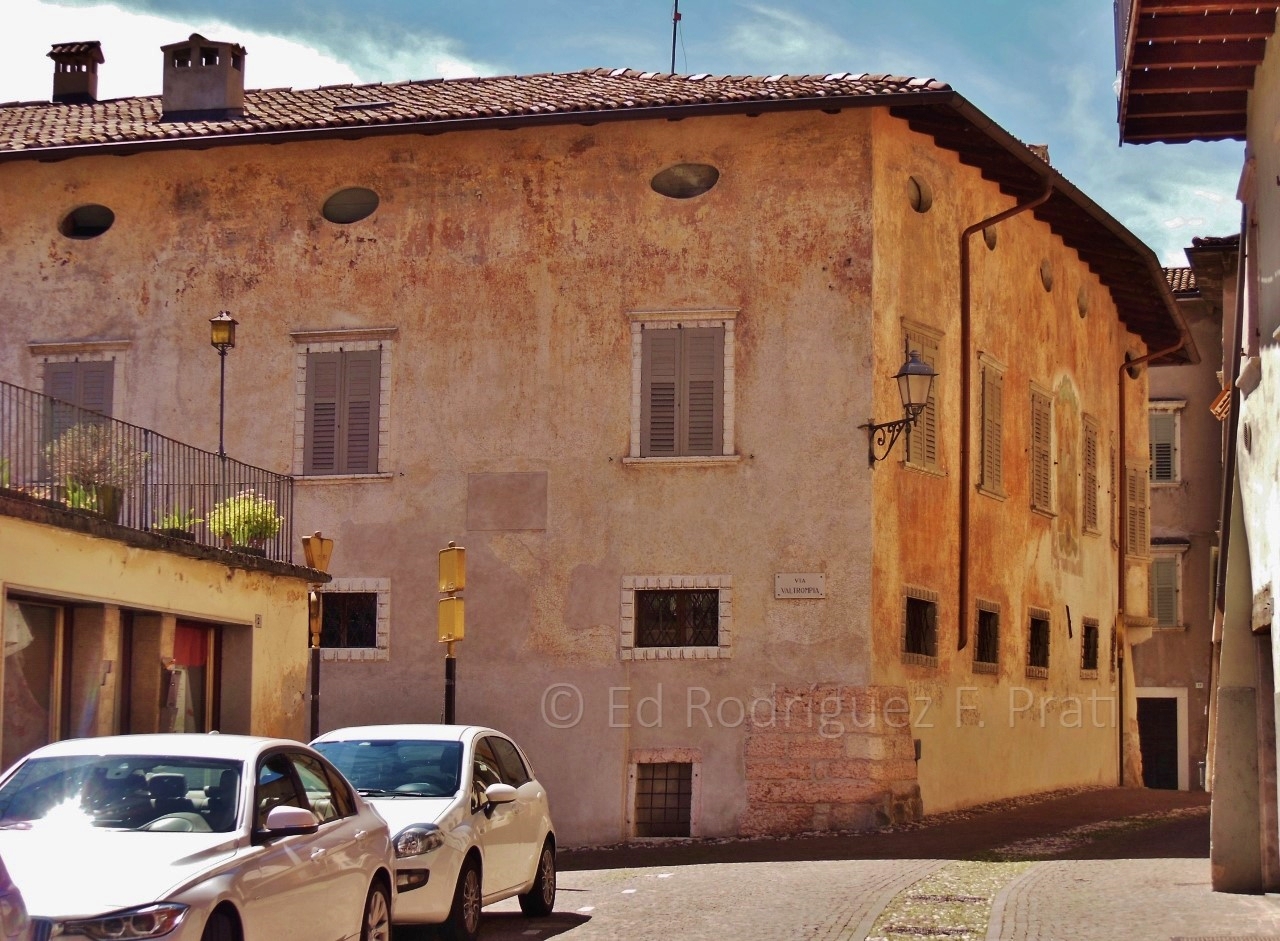
Views of Palazzo Madernini


Note : Photos taken by me in Villa Lagarina and Nogaredo in august 2016

jueves, 13 de septiembre de 2007

Conde Paris de Lodron - Count Paris of Lodron - Graf Paris von Lodron - edited jan.2017

Un homenaje al Conde Paris de Lodron, antepasado de las casas reales europeas (quién inspiró el Paris de “Romeo y Julieta” de Shakespeare)
An hommage to Count Paris of Lodron, an ancestor of European reigning houses (who inspired Shakespeare’s Paris of “Romeo and Juliet”) 

Paris de Lodron y su descendencia (with new additions of january 2017)

Paris of Lodron and its descendance (English translation of january 2017)

Si la nobleza representa el reconocimiento de una determinada preminencia en una determinada época (ver artículo en éste blog), que el gobierno de los hombres quiso se perpetuara muchas veces inmerecidamente, diré que siento orgullo de algunas de mis raíces nobles. Más aún de los para mi más legítimos “nobles” de quienes desciendo, aquellos que son famosos por sus logros además de por su origen. Como Paris “el grande” de Lodron, caballero que vivió a caballo entre los siglos XIV y XV (fallecido 1439), sin duda valeroso guerrero como para, siendo un noble de provincia de una zona limítrofe entre Brescia y Trento, merecer el grado de General de la Serenísima, la República de Venecia, y obtener de la misma el condado de Cimbergo.

If nobility means the recognition of a certain preeminence in a specific time, that the government of men wants to perpetuate many times undeservedly, I am proud of some of my noble roots. Even more of those most legitimate "nobles" from whom I descend, those that are famous for their achievements and not only for their origins. As Paris "the great" of Lodron, knight who lived between c. XIV and XV (died in  1439), undoubtedly so brave warrior as, being a noble of the area between Brescia and Trento, deserve the honor to be General of the "Serenissima", the Republic of Venice and to obtain of it the county of Cimbergo.

Había combatido por la Serenísima contra las tropas de Gian Galeazzo Visconti en las montañas de Brescia ya en el 1401, socorrido al Gattamelata en Brescia en julio de 1438 y el mismo mes liberado la Val Camonica junto a Bartholomeo Colleoni, ayudado en setiembre del mismo nuevamente al Gattamelata en su retirada de Brescia a Verona, y al mismo tiempo reconquistado su territorio. Enero del 1439 lo encuentra victorioso en numerosas acciones militares pero en febrero debe rendirse en Castel Lodrone. En abril moría a causa de la fiebre. Su fama fue tal en su época que se reflejó en el personaje del Paris prometido de Julieta en la novela italiana de “Los amantes de Verona”, del autor vicentino Luigi Dal Porto, que el gran Shakespeare transmutó en la obra inmortal de “Romeo y Julieta”.

He had fight for  the "Serenissima" against the troops of Gian Galeazzo Visconti on Brescia mountains already in 1401, helped the Gattamelata on july of 1438 and the same month liberated the Val Camonica together with Bartholomeo Colleoni, helping again the Gattamelata in september on his withdrawal from Brescia to Verona and at the same time reconquered his territory. January of 1439 find him victorious on many military actions, but in february must surrender in Castel Lodrone. In april died cause of the fever. He was so famous in his time, that was reflected in the character of that Paris promissed to Juliet in the italian novel "The lovers of Verona" of the vicentine author Luigi Dal Porto, that inspired the great Shakespeare's immortal play "Romeo and Juliet".

De Paris el Grande descienden todas las actuales casas reinantes de Europa, a través de la línea de su hijo el Conde Giorgio y su nieta (bisnieta  para algunos genealogistas) countess Anna de Lodron, por su segundo matrimonio con el Reichserbschenk Erasmus von Limpurg (primero fue cónyuge del célebre militar Georg von Frundsberg, creador del cuerpo de los “lansquenetes”, gestor de la victoria contra Francisco I de Francia en Pavia en 1525 entre muchas otras hazañas), Pero tambien a través de la línea de su hijo el Conde Pietro y su nieta la condesa Giulia de Lodron de su matrimonio con el Conde Alessandro d'Arco (de otra potente familia noble trentina). Ambas líneas convergen en el S.XVIII en la Csa, Luise Reuss-Schleiz, casada con el Duque Johannes August de Sachsen-Gotha, y posteriormente muchas otras veces.

From "Paris the Great" descend all the actual ruling houses of Europe, through the line of his son the Count Giorgio and his granddaughter (great granddaughter for some genealogists) Anna of Lodron from her second marriage, with the Reichserbshenk Erasmus von Limpurg (she was first the wife of the famous Georg von Frundsberg creator of the body of the "landsknechts" responsible of the victory against Francis I of France in pavia in 1525,  between many feats). But also through the line of Count Pietro and his granddaughter countess Giulia of Lodron from her marriage with Count Alessandro d'Arco (of other powerful noble trentine family). Both lines converge in the 18th c. on the countess Luise Reuss-Schleiz, married the Duke Johannes August of Saxe-Gotha, and later once again many times.

Tanto Elizabeth II de Gran Bretaña como su marido el príncipe Philip de Grecia, así como Juan Carlos I de España y su cónyuge Sofía de Grecia (los tres últimos por varios “costados”), pasando por la mayor parte de las familias de la alta nobleza, sobre todo germánica, cuentan entre sus antepasados con las mentadas condesas Anna y Giulia de Lodron. Las líneas principales pasan por dos distintas estirpes de los Condes de Erbach ( la de Fuerstenau y la de Schonberg) para desembocar en las casas de Sajonia-Coburgo-Gotha y de Sajonia-Hildburghausen, y  los condes de Wolfstein para culminar en las de Dinamarca y de Sajonia-Weimar-Eisenach, que llegan a fines del S.XIX entroncadas con casi todas las casas ya reinantes o pretendientes de Europa o constituyendo nuevas dinastías (Bélgica, Bulgaria y Rumania). Los cuatro abuelos y cinco de los bisabuelos del actual Rey Felipe Juan de España descienden de ambas líneas y otro bisabuelo de la última mentada línea de Wolfstein.

Elizabeth II of Great Britain as his husband Philip of Greece, as Juan Carlos I de España and his wife Sophia of  Greece (the last three by several sides), passing through most of the families of the high nobility, chiefly germanic, count between their ancestors the referred countesses Anna and Giulia of Lodron. The principal lines pass mainly through two lineages of the Counts of Erbach (those of Fuerstenau and of Schonberg), to reach the houses of Saxe-Coburg-Gotha and of Saxe-Hildburghausen and a line of the Counts of Wolfstein to reach the house of Saxe-Weimar-Eisenach, arriving to the 19th c. linked with almost all of the already reigning houses of Europe or constituting new dinasties (Belgium, Bulgaria, Romania). The four grandfathers and five of his greatgrandfathers of  actual King Felipe Juan de España descend of both first mentioned lines and another of the last mentioned line of Wolfstein.

¿Acaso podía haber imaginado Paris el Grande desde su modestos feudos provincianos semejante destino para algunos de sus descendientes? Entre tantas líneas de sucesión, algunas mantienen su lugar en el Trentino de origen, más o menos modestas, como las muchas líneas ilegítimas de la Val Lagarina, una de las cuales está entre las de mis antepasados. En general protegidas por sus padres, algunos de ellos sacerdotes, de la rama de los mentados condes tb. señores de Castellano y Castelnuovo (o Noarna), cuyo principal exponente fue otro Conde Paris de Lodron (1586- 1653), Ppe. Arzobispo de Salzburgo , enlazaron con buenas familias de la nobleza o la burguesía locales. De allí que otras familias de mis ancestros, cuyas líneas convergieron con las de los cónyuges de estos ilegítimos “de Casa Lodron" (como eran llamados para distinguirlos de las líneas legítimas) también se pueden encontrar en el tronco de algunas de las casas reales antes mencionadas, como los altoatesinos Botsch von Zwingenberg (curiosamente de origen florentino). La línea de Vallagarina era además descendiente de los potentes Niederthor, familia principal de Bolzano que también se encuentra en muchos troncos reales a través de largos caminos que confluyen en los Savoia. 
.
Could have imagined Paris the Great, from his modest provincial fiefs such a destiny for some of his descendants? Between the many lines of succession, some still are in their original Trentino, more or less modests, as many of the illegitimate branches of Vallagarina, one of which is part of my ancestry, Generally protected by their fathers, some of them priests, of the branch of the counts that were also Lords of Castellano and Castelnuovo (Noarna), whose principal exponent was another count Paris of Lodron (1586- 1653), Prince Archbishop of Salzburg, linked with good families of the local nobility and bourgeosie. So other families of my ancestry, whose lines converged with that of the spouses of that illegitimates of "House Lodron" (as were called to distinguish them of the legitimate lines), can be found in the stem of some of the royal houses mentioned, as the south tirolers Botsch von Zwingenberg (curiously of florentine origin). The line of Vallagarina was also descendant of the potents Niederthor, a principal family of Bozen that can also be find in the stems of many royal families through long paths that join in the house of Savoy.


En homenaje a mi quintoabuelo, de quien provienen estos vínculos de sangre por su parte materna -familia Mallengo de Vermiglio y Arco-, el “nobile” Gioacchino de Negri de Montenegro (1743- d. after 1800) (nieto del Nobile et Spectabile Angelo de Nigris –n. 1676-, notario colegiado de Arco, y del Nobile et Spect. Stefano Michele Mallengo, Notario, Canciller de Castel Penede, y sobrino de otro Gioacchino de Negri -1718-1798-, Mayor de la armada imperial y de otro Angelo de Negri, Dr. en Leyes y Comisario de Arco, hermanos a  quienes la Emperatriz María Teresa otorgó en 1774 la nobleza del S.R.I y el predicado noble), y a la antigua forma del apellido usada por varias generaciones, he adoptado el nombre que empleo como seudónimo a efecto de estas páginas:
                                                                                                      

As an hommage to my fifth grandfather Gioacchino de Negri di Montenegro (1743-a. 1800), from whom come this links of blood, of his maternal side, Mallengo family of Vermiglio in the branch of Arco) grandson of the "Nobile et Spectabile Angelo de Nigris" -b. 1676-, collegiate notary of  Arco, and of  "Nobile et Spect. Stefano Michele Mallengo, notary, Chancelor of Castel Penede jurisdiction, and nephew of  noble Gioacchino de Negri -1718-1798-, Major of the imperial Army and of other Angelo de Negri, Dr. in Law and Comissar of Arco, brothers to whom Empress Maria  Theresia elevate to the Imperial Nobility in 1774 with the predicate of Montenegro, and to the ancient way of the nickname, "de Nigris" used by many generations, I have assume the name that I use for this pages:

                                                                                                       Joachim Stefanus de Nigris


The family Endrizzi de Cillà (also known as de Cillà and Cilladi) from the Principality of Trento / First Part

  This article is about the lines of Assesors, Chancellors and Lieutenants of Castel Stenico, under Princes Madruzzo of Trento First pro...