martes, 29 de mayo de 2018

Angelini de Massone e Prabi - Angelini von Massonendorf und Brabienhof (First Part)


    Stemma nel portale di Villa Angelini - Massone di Arco                     fotos E. Rodríguez F. Prati , august 2016
This notorius noble family of the county of Arco, settled in this place after the 2nd. marriage of Sebastiano Anzelini, was originary from Besenello, a town at the Valley of river Adige, beside Castel Beseno [Castel Beseno is the  biggest fortress of the province of Trento,  and was built by the powerful counts of Eppan (Appiano in italian), with the Prince bishops permission, in the 11th. Century. It was ruled after some centuries by the family called “de Beseno” after it, followed by the potent family “de Castelbarco”, and since 1470 by the Trapp family as feudataries of the Princes of Trento. In those times the Trapp, of styrian origins, also began their domain on the ancient fiefs of the Lords of Caldonazzo and Ivano. This branch is called Trapp zu Pisein (germanized form for Beseno), the cadet one of the family settled in Matsch, called Trapp zu Matsch].
Castel Beseno seen from the railways - august 2016

The territories of the southeastern part of the Principality of Trento, the “Pretura of Rovereto”, neighbor of Beseno fief, were dominated by Venetia in the 14th c. The original spelling of the nickname of Angelini, before settling in Arco, was Anzelini, as it is still today in Besenello, and so seams to be clear their origin in Venice, as Anzolo is the form of Angelo in the venetian dialect. In the town of Besenello is located “Via degli Anzelini” (street of the Anzelinis), where the family had their houses.

That “Domino Sebastiano Anzelini” origin of the nobles Angelini of Arco, was the son of Pietro Anzelini and Cristina (whose nickname still couldn't find), and was born probably in Besenello about the year 1600, but we could'nt find the baptism act together with those of his siblings in 1595, 1603, 1607 and 1611...1 That lagoon of 8 years from 1595 to 1603 may indicate that his father Pietro could have moved temporary to another town as Nomi, or Rovereto...

The fact is that Sebastiano and his wife, Donna Ginevra Benvenuti, were baptizing their first and only son, Pietro, on october 4 of 16242, being his godparents the Egregio Signor Pietro Benvenuti, Nomi's Chanceler, and the Sigra. Angelica Chiusole, wife of Sigr. Giustiniano Chiusole di Trento... Pietro Benvenuti was certainly the grandfather of the child as he had a daughter named Ginevra baptized on march 3 of 1605 in the little village of Chiusole3. Benvenuti and Chiusole are the same family, ancient feudataries in Chiusole from the 1200, and the branch living in Trento, that used first the form “Benvenuti de Chiusole”, used since XVI c. only “de Chiusole”. Pietro Benvenuti and Giustiniano de Chiusole were close relatives, both descending of a Ser Antonio Benvenuti de Chiusole, citizen of Trento, who had died in 1516, a very wealthy man, as he had posessions in Nomi, Aldeno, Pomarolo, Piaz, Chiusole, Lizzana, near Rovereto, near Torbole, and three houses in Trento (one with two towers). He also had family sepultures in S. Cristoforo of Pomarolo and in the Altar of S. Filippo Neri in Sta. Ma. Maggiore in Trento.
Ginevra's mother, Isabetta, was highly probable a member of the Gardumi family, what help to explain why Sebastiano moved after to the County of Arco, where a branch of that family was florishing since the end of the 1500.
Dno. Sebastiano Anzelini was a widower soon after his first son, Pietro, was born, and on 3 of november of 1627 married secondly Catherina Regaiolli4, from Bolognano di Arco, the daughter of Floriano Regaiolli and Antonia Tamburini, from an old family of the county of Arco. The wedding was held at the church of Bolognano, but they moved to Besenello where were borne their first daughters, twins who were baptized as Cristina and Antonia5, as both their grandmothers. After that was born in Besenello a girl, baptized also as Antonia in 1629, and the following, another Antonia was born in Bolognano in 1633, were they had moved escaping from a plague focus in Vallagarina as said some fonts cited in a Census of Arco of 1787.
The fourth child of the couple, another girl, was baptized with the name of the first wife, Ginevra, on oct. 1635 at Bolognano.
After her came Catharina, Francesco, and a first Valentino, on 1637, 38, and 42 respectively, all baptized in Bolognano. The last died as a child if the following was baptized in 1645 with the same name again, Valentino Carlo (a nodar when adult), but already in the church of Massone di Arco, a part of the Oltresarca community, where they have moved and probably began already the construction of what would be with the time one of the beautiest villas of the county. The following child was a girl , baptized as Domenica in 1648, who died early, followed by another Domenica in january 1650, twentyfive years younger than his half brother Pietro.6, who married Domino Giacomo de Nigris from Massone (origin of Negri de Montenegro by her son the nodar Angelo).
Pietro became an important neighbour named when adult as Magnifico Domino Pietro Angelini, citizen both of Arco and Oltresarca, what means he had properties also in Arco, head of the County ruled by the Counts of Arco. He married in Trento on 1665 a rich lady, Dna. Anna Maria Cimonati, daughter of Magnifico Leonardo Cimonati, Magister foundry, and Domina Catharina Tanvini, the daughter of a very wealthy Magister foundry, Magnifico Domino Adamo Tanvini*, from Male in the Val di Sole, who had doted her with the important amount of 400 rainesi, as her other sisters following the testament of Adamo.7 Catharina's brothers, the nodar Giacomo Tanvini, and the priest Francesco, reached the rank of Ritters of the Holy Roman Empire with the predicate of von Meletto, having bought in 1679 a fief in Dalmatia named Meledo by a huge amount of money... The eldest brother, the priest Dr. LL Giovanni Battista, already dead before that, had obtained the arms for the family together with the Law Doctorate in Bolonia in 1640, and after was a Canon in Bressanone. So Magnificos Dominos Tanvini became Illustris Ritter Tanvini von Meletto, and their descendants obtained another distinction becoming von Tanvini zu Meletto und Walchenhoff since 1707, living then no longer in Male but in Caldaro/Kaltern, where they had built one of the most beautiful noble houses (edelsitz) of that town, known as “Tonvin haus”, now the seat of Caldaro's Major.

[*Note - The family Tanvini was originary from Ossana following Don Bottea (genealogist priest of 19th. c) and has no relation with family Panevini already living in Samoclevo when Tanvinis moved about 1550 to Male, in any document Tanvini appeared as Panvini as some trentine fonts mention. Afther moving to Caldaro they are also known as Thonvin. It's extaint since the beginning of 19th c.]


Returning to the family of Magnifico Domino Pietro Angelini and Anna Maria Cimonati, they had seven child, being the firstborn baptized with the name of Sebastiano, as his grand father, in 1666, who would be a prominent nodar of the county of Arco, followed by five girls, Ginevra, Catherina, another Ginevra, Elizabetha and Lucrezia, and finally another boy, baptized Leonardo Valentino, as his grandfather Cimonati and his uncle Valentino.
The girls married into families Canevaro, de Tomasi of Varignano, and two of them into the family Angeli of Dro, these last with succesion, between 1689 and 1700. Of Leonardo Valentino we have no further notices but Sebastiano (II) was the beginning of a dinasty of nodars and lawyers, following the steps of his uncle Valentino Carlo, nodar.
The “Nobile et Spectabilis”** Valentino Carlo married the Nobile Camilla Amistadi, the only daughter and heir of the “Nob. et Splis.” Francesco Amistadi, Chanceler of Arco since 1648 and Vice Comissar of the county since 1657. The marriage was held in 1662, some months after the death of her father. The mother in law of Camilla was Nob. Domnina Gardumi, daughter of the Nob. et Clarissimo Dr. Carlo Gardumi, Dr. in Law and also Commissar of Arco. As can be seen the family always was in the circle of the burger patriciate of Arco, after they became nobles of the Holy Roman Empire.
[**Note - Nobile et Spectabilis was the honorific treatment used for the nodars, before called as Egregio, denominations of roman imperial origin]

Returning to the line of Pietro's son Sebastiano (II), his godparents were the Perillustris et Exmo. Dr. Bartolomeo Malsona, then Commisar of Castel Penede jurisdiction, and the mentioned lady Nob. Domnina Gardumi.
He worked as a collegiate nodar of Arco since 1692 until 1731. In 1698 he married the Nobile Antonia Taddei of Croviana, eldest daughter of Nobile Giacomo Antonio Taddei by his first marriage with Antonia Martinelli, at the time married secondly with Nob. Joana Panevini, daughter of the Asessor of the Val di Sole Dr. Giovanni Panevini and a Pilati of Tassullo. No wonder why Sebastiano was related with Croviana if his grandmother Catharina Tanvini was of a family from Male, a neighbour village distant only 2 miles from Croviana, and Taddei family was already related with Tanvini family by the marriage of a granduncle of Antonia, Lorenzo Taddei, with a grandaunt of Sebastiano, Anna Tanvini. Taddei family was one of the most importants of the place since the early 1500, being of the men of trust of Counts Thun since then, and aparently was related by blood with Barons Pezzen (Don Bottea, a genealogist priest of 19th c.  noted that, I found many clues in that way, but we'll analize that theme in a future article). So the marriage took place in the little church of S. Giorgio of Croviana with the presence of Sebastiano's cousin Illris. Adamo (II) Tanvini (Noble of the HRI), and his uncle, Nob. Domenico Cimonati (a nodar in Trento). The bride, Antonia, was a very rich heiress, and of the entourage of Counts Thun of Croviana, goddaughter herself of countess Anna Massenza Ginevra von Thun.

Probably were present in the ceremony: her father, Nobile Giacomo Antonio Taddei, with his wife, her mother in law, Nob. Joana Panevini-Pilati, their cousins in common, that's Domino Gian Michele Taddei-Tanvini and his wife Nob. Lucia Carelli, and Domino Antonio Taddei-Tanvini with his third wife Marina Conci-Bevilacqua (also a relative of both of the new couple), and possibly being there in the ceremony, of the uncles Taddei only Bartolomeo (because Nob. LL Dr. Giovan Michele, and Nob. Gianbattista were probably in Tirol where they lived, and Elizabeth married a Bezzi of Cusiano had died the year before). There could have been also present Antonia's cousins Domenico, Cristoforo and Catharina Bezzi-Taddei, who where contemporaries of Antonia an lived in the near village of Cusiano.
From Tanvini family only a few were living still in Male as Adamo already mentioned, and were in far places... We think that if Illris Dr. Domenico Tanvini, elder brother of Adamo (II), was present, he would have been the main testimony.
Certainly were also many other relatives and friends of the main families of Croviana, Male and Magras, Dimaro, Cles, etc. as members of families: de Angelis, Belleni of Cles (family of Antonia's grandmother), de Bevilacqua, Antonietti, Bertucchi (Dr. Giovan Tomasso Bertucchi was married with the mother of Antonia's mother in law, Nob. Joana Pilati de Tassullo, widower of Giovanni Panevini), Conci, Fiorini, Lorengo (ancient nobles of Caldes), Martinelli (family of the bride's mother, from Dimaro), Ramponi of Magras, many times related along two centuries, the recently arrived Sartori, from Piano, who had bought the ancient fief of Belveder, Scaramella, of Caldes, and many others, almost all nobles or high burgers of those communities. We can think it was impossible the assistants can enter in the little church of S. Giorgio, so most were located probably at the road in front of it.
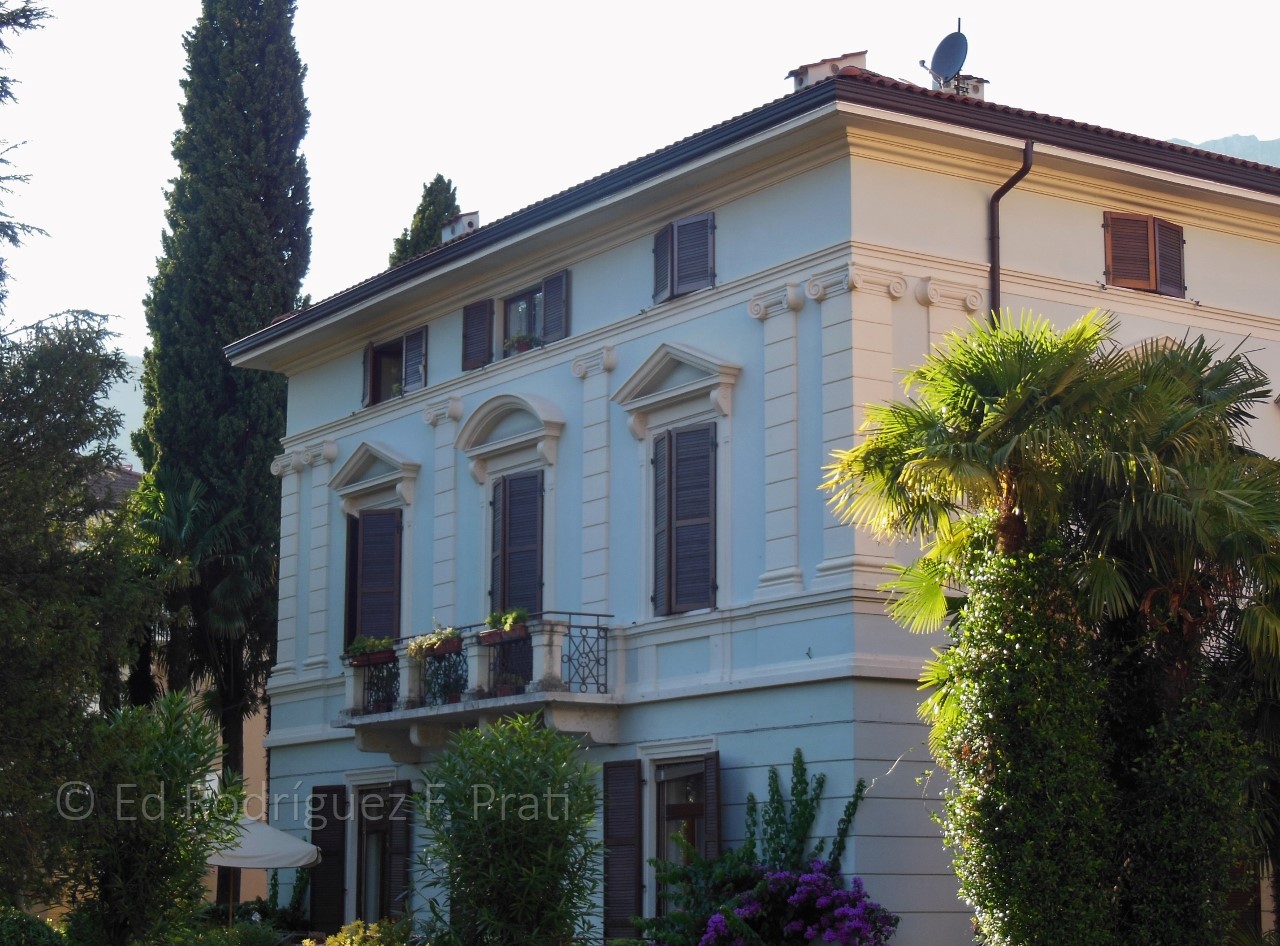
The new couple settled in Massone di Arco, in the beautiful villa at a border of the village facing the sun and the air that comes from Lake Garda. 
Villa Angelini a Massone di Arco ( in XX c. Caproni) - august 2016

They give birth to twelve sons between 1700 and 1721, of whom at least 7, three men and 4 women, reached the adult age, having one son, Giacomo Antonio (* 1708), inherited the office of nodar, and becoming Chanceller of Arco jurisdiction, origin of the branch ennobled as Angelini von Massonendorf und Brabienhof, and the other two male sons become priests, Pietro (Canon at the Collegiate Church of Arco), and Giovanni Battista. The four women married into families of social position, Anna Maria (* 1700) with a Domino Pietro (Barthei ?) of S. Massenza, Catarina (* 1703) with Dno. Giovanni Vincenzo Danieli from Lasino, who will become the origin of the family of captains and administrators of Castel Ivano in Valsugana, and so known as Danieli de Ivano, (Danieli-Vallandro/Danieli-de Gera and Danieli-Vettorelli/Danieli-Castelrotto) family who will also become related with their relatives Negri di Montenegro (see the article in this blog), Joana (*1707), who married Domino Giovanni Alovisi, from Mogno di Arco, of one of the wealthiest families of the County of Arco, owners of a great Villa in Mogno, also related with Negri de Montenegro family whose mother was Adornina Alovisi, whose descendance will become of the main importance in the offices of the county on 19th c., and finally Ginevra (* 1717) married to Domino Giovanni Battista de S. Pietro or Sampieri, resident in Arco but from Novara, mother of Lucia Sampieri, wife of Gioacchino Domenico Negri (de Nigris, de Negri, Negri di Montenegro) who was also descendant of Angelini family by Domenica f. Pietro f. Sebastiano already mentioned, so they married under dispense of consanguinity...
We will continue this article in a 2nd. part in the future with the branch of Nobles of the HRI descendants of Giacomo Antonio Angelini and Barbara Marcabruni. (Angelini-Caneri/ Angelini-de Prati/ Angelini-Grimani...)

June 29, 2018
Edmundo Rodríguez-Fosalba Prati  


1Book of Baptisms, Besenello, Microfilm Nr.
2Book of Baptisms, Nomi, Microfilm Nr.
3Book of Baptisms, Nomi, Microfilm Nr.
4Book of Marriages, Arco, Microfilm Nr.
5Book of Baptisms, Besenello, Microfilm Nr.
6Book of Baptisms, Arco, Microfilm Nr.
7Tovazzi, G., Compendium diplomaticum sive tabularum veterum N. 489

viernes, 11 de marzo de 2016

The social ascension of Madernini family at the late XVI century

The social ascension of Madernini family at the late XVI century, through a marriage with a member of their protector Lords family, Counts of Lodron


Many years ago, searching for familiar traces in the parish archives of Villa Lagarina, I found a relevant document that explains clearly how began the Madernini family raise, from simple officers of the lodronian administration of their fiefs in the Val Lagarina region of Trento (Castellano and Castelnuovo), to be one of the prominents families of those places.
The document is a marriage act, strangely never mentioned in any source about Madernini family, that involves a lady of the Lodron family, whose name was Virginia, with a member of the Madernini family.

 Lodronian Lion at the palace
 Lodron in Nogaredo built by 
 Count Nicolo II and Castle
 Noarna or Nuovo behind


As it is said in the act, she was a natural daughter of Count Paris (VI) (born c. 1525-1566), undoubtedly the son of Count Nicolò I (1475-1556) from his 2nd marriage with Css. Beatrice de Castellalto. Count Paris VI was rightfully married with Barbara von Lichtenstein-Kastelkorn with whom he previously had at least five children, the elder of whom was count Nicolò II (1549-1621), who with his first wife, Dorothea von Welsperg, will be the father of the famous Prince Archbishop of Salzburg, Paris von Lodron (1586-1663), a few years after the marriage of Virginia, Nicolò's II half sister as was said, and so an aunt of the prestigious prince...
The name of Virginia's mother is never mentioned in any of the documents I had access, but was probably a lady of the lodronian environment and not a woman of low condition, as members of the family were present in the ceremony of their marriage. Many counts of Lodron had illegitimate childs, almost all socially recognized as 
that as one can see they were always protected by their fathers and relatives, and held important positions in the region... The most extended branch was that called first “de Casa Lodron de Santo Antonio”, cause of the place of Santo Antonio in Pomarolo, descendants of the priest rector of Pomarolo, Count Andrea (c. 1480-1550), one of the sons of Count Paris IV and the venetian noble Veronesa Coppo. Other was that of the descendants of Andrea's brother, the priest Count Alessandro, branch after called Rinaldi, cause of the name of his natural son Rinaldo.
For all of them it was styled to use not the nickname of “de Lodron”, but that of “de Casa Lodron” (of the House Lodron). Counts of Arco use the same way to identificate their illegitimate childs as not like “d'Arco” but as “de Casa de Arco”. There were other lines identificated also with the places of birth, like the line of “de Casa Lodron de Pedersano”, and “de casa Lodron de Villa (Lagarina)”, of whom I can not still identify precisely their origins but were certainly all descendants of Paris IV and Veronesa Coppo.
For all of them was used the honorific treatment of “Messer” or “Madonna”, and never that of Count or Countess reserved for the legitimate descendance.
The line of Villa Lagarina seems to be descendants of the early youth of Counts Felice (c.1530-1584), or Agostino II (1525-after 1574) sons of Count Agostino and the noble of Padova Maddalena Bagarotto. In the first case Messer Auxilio de Casa Lodron would have been the son of a young count Felice of about 15 years, as he may was born about 1545 and not after 1547, having himself baptized his daughter Giulia in 1562... Felice is a more probable father cause Agostino studied in Merano and after was a squire of a Bohemian king...
But let´s return to Virginia, at her marriage with Messer Giorgio Madernini were present the “Magnifico Signor Antonio de Casa Lodron de Sto. Antonio”, the most prestigious of the illegitimate members of the family as a testimony of what we told about she was considered a part of the family.
Virginia was already carrying a son of Giorgio because their first son, called Madernino as his paternal grandfather, was born only a month and a few days after the marriage... His godmother was the “Sigra. Dorothea de Lodron de Sto. Antonio” and the godfathers (more than one, what then was usual) a Messer Giovanni son of Girardo Madernini and the “Magco. Sigr. Raffaele Marchi” of Florence.
Madernino Madernini was baptized in Nogaredo on 19 april 1582. He married about 1607 the “Nobildonna Lucrezia” who was probably of a noble family of Rovereto, cause the act of marriage doesn't exist in Villa Lagarina records, and many of the godparents of their children belonged to the noble families Rosmini, Telani and Costioli of that place, appart from those from the Lodron family as Madernino's uncle Count Nicolò II, godfather of Paris Madernini on 1610, his cousin countess Barbara, godmother of Catharina Madernini in 1613, who was Nicolò's daughter and sister of the future Salzburg's Prince Archbishop Paris de Lodron, himself godfather in 1614 of my possible ancestor Francesca Madernini, Count Massimiliano (1576-1635), a half brother of Paris VI, and so granduncle of Madernino, godparents of Francesco Hieronimo Madernini in 1617 together with Css. Anna Maddalena von Thun-Bragher, the first wife of Count Alfonso de Lodron, a brother of the already mentioned Massimiliano.
The Madernini were already in the first line of the families of Villa Lagarina though another marriage will strengthen that position, that of Paris Madernini, borned in 1610, already mentioned, with the Noble Orsola Priami, also borned in Villa Lagarina in 1610, the daughter of Noble Ippolito Francesco Priami and the Noble Lucrezia de Coredo or von Coreth, granddaughter of the Captain of Villa Lagarina Alberto Priami and Noble Orsola Battaglia, greatgranddaughter of Messer Nicolò Priami, originary from Verona, Vicar of the jurisdiction of Villa Lagarina for the Counts Lodron in the middle of XVI century.


Palace Priami- Madernini in Villa Lagarina

Their son Giovanni Alberto Madernini, borned in 1644 would be Imperial Notary in Villa Lagarina from 1672 to 1720, and would marry in 1672 the Noble of Trento Claudia Particella, daughter of Gian Gaudenzio Particella, of a family of the first line of the entourage of the Princes of Trento, favorites of the Princes Madruzzo, and a nephew of another Claudia Particella who was the lover of Carlo Emanuele Madruzzo (1599-1658) the last Prince Bishop of that dinasty. His grandsons Giuseppe Alberto and Francesco Antonio would access to the Nobility of the Empire as Adels von Taubenberg. The blood of Giuseppe Alberto still remains in two branches of the family Marzani of Villa Lagarina, nobilitated as Marzani von Steinhof in 1769 and that reached to the title of Counts Marzani von Steinhof und Neuhaus in 1790, at the same time that many other powerful families of Trento. One derives from Giuseppe Alberto's son, Adamo Madernini von Taubenberg, and Bss. Maria Felicitas Ceschi de Sta. Croce (Freiherren line), whose daughter Rosina borned in 1803, married Count Agostino Marzani v. St. u. N. And the other from Giuseppe Alberto´s daughter Maria Theresia Madernini v. T. who married Count Giorgio Federico de Montalbano, and whose daughter Maria Guglielmina de Montalbano married Count Lorenzo Marzani v. St. und N., a brother of the mentioned Agostino.
Francesca Madernini, borned in 1614 and already mentioned, married a Noble Domenico____ of Brentonico, whose nickname in the marriage act dated january 25th 1633 in the books of Villa Lagarina is missed, probably cause the marriage wasn't held there but in the Church of S. Carlo of Rovereto, what reinforces my idea that Noble Lucrezia, Francesca's mother, was of a roveretan family.
I finally found very probably that Domenico belonged to the Donati family cause they had many descendence in Brentonico in which the name Madernino appeared frecuently and other previous reasons between the relationship of both families, but that is the subject of a future article...
                                              March 11th, 2016
                                              Edmundo Rodríguez-Fosalba Prati     


Views of Palazzo Madernini


Note : Photos taken by me in Villa Lagarina and Nogaredo in august 2016

martes, 2 de octubre de 2007

La famiglia Giordani / de Jordanis di Vezzano - Prima Parte (Aggiornato 30.7.2017 e 15.9.2019)


La famiglia Giordani o de Jordanis de Vezzano ebbe inizio in torno al Trecento, ed essi appaiono già col cognome essato, comme sindaci da Vezzano in documenti fino al inizio dal 400. La villa da Vezzano e una dalle piú antiche localitá dal Trentino già che ha origine nel oppidum romano menzionato comme Vitianum.(vedi in www.valledeilaghi.it/cms/comune-di-vezzano.html , ed in http://www.comune.vezzano.tn.it/ , in Territorio e Storia - Le frazione - Vezzano) Non sappiamo oggi si hanno cualche relazione col Giordani di Molveno, localitá relativamente prossima a Vezzano, dato che il origine patronimico dal cognome non permete aseverare questo. Gli armi di ambidue hanno stelle nel disegno, ma quello non prova niente perche tale figura araldica e molto commune nella regione, tanto nelle arme de famiglie dei “gentiles” (nobiles rurales) comme in altre che ebbero la nobiltá imperiale (Torresani per ess.) o matricolata dal Tirolo (Altspaur per ess.). I Giordani di Vezzano furono innalzati alla nobiltá dal Impero per l’imperatore Ferdinando nel 1546[1], essendo giá personne di spicco nella Vezzano dal quattrocento comme se trovano menzionati in documenti anteriori. Francesco Giordani (francisci zordan –sic-) e citato comme sindaco da Vezzano in uno documento[2] redatto a Trento nel 2 set.1429 in una controversia tra le comunità da Cadine, Civezzano, Sopramonte e Terlago da una parte e quelle da Calavino, Lasino, Povo e Vezzano dal altra, ed in altro documento[3] redatto a Vezzano nel 10 gennaio 1478 se fa menzione a una “regola” reunita nella casa dal Ser Giordano figlio dal defunto Francesco Giordani (domo s[4] jordany qd s francisci jordany – sic-). I domini Filippo e suo fratello Francesco, furono investiti nel Castello del Buonconsiglio, nel 4.12.1545, di una casa in Vezzano, vicina Reversi, Bellesini e Carpella, ed un altra volta nel 14.5.1565.[5]
I piu noti membri de questa famiglia furono nel sec. XVI il Nob et Magco. Baptista de Jordanis -sic-, personaggio di spicco in torno ai Madruzzo, fratello dal menzionato Filippo, ed il Nob. et Splis. Joannis de Iordanis, notaio e capitano de Vezzano, figlio da Filippo.  Corrisponde al sepolcro dal primo la lapida stemmata che existe nella chiesa di Vezzano, oggi non piu nel suolo ma adossata nelle mure dalla facciata all’interno, datata 1574. Il secondo apparisce in molti documenti dalla seconda metà dal’500 e i primi anni dal ‘600. Nelle fine dal secolo XVII i Giordani ebbero distacco nella corte dal Ppe. Vescovo Francesco Alberti de Poja –e possibile che parentati collui atraverso familie dalla Giudicarie comme i nobili Endrizzi de Cillá (anche Cilladi ) dal Bleggio inf. da che discendono questi Giordani, o forse comme i Serafini / de la Bona da Villa Banale-. Attuarono in quella corte il Nob. Aliprando de Jordanis, nipote dal citato notaio Giovanni, comme “Camerarius” o sia amministratore dal vescovo, ed il Nob. Joannis de Jordanis, -pronipote dal medesimo notaio, figlio dal Nob. Aldrighetto de Jordanis, cittadino de Trento e fratello di Aliprando-, che apparisce in documenti comme “Stafferius” o sia scolta. Altra figlia di Aldrighetto, la Dna. Catharina de Jordanis era maritata con il Magco. Dno. Giacomo Garbari, da vecchia famiglia da Vezzano, che ebbero sucezione nel ramo piu prestigioso de questa famiglia, con rampolli in Vezzano -che allacció nel ottocento con i nobili de Eccher de Mezzocorona- ed anche in Caldonazzo nel fine settecento – allacciarono ai de Negri da Calavino (vide in questo blog)-. Questi furono propietari dalla Filanda Garbari e poi dal Hotel Caldonazzo, e dalla medesima un ramo abitó anche in Pergine (fine ottocento), quello dal pittore Tullio Garbari. Dal mentato Nob. Joannis de Iordanis, maritato la Nob. Anna Maria Marinelli, da Trento de origine Nonese, derivó un ramo in Trento, sempre cittadino il di cui existe tuttavia discendenza. (continuerá).
Joachim Stefanus de Nigris
Fonte - Grale.- Archivio Arch. Rodríguez-Prati (piú de 10000 atte de Batessimi - Matrimoni e Defunzione dalla Diocesi da Trento) - Salto - Uruguay [1] - G. Rauzi - Araldica Tridentina - pág. 161 [2] - Nel Sito Web Trentino Cultura (http://www.trentinocultura.net/ ) en Catalogo – Inventari fondi archivistici – Pergamene on line - Arch. Com. Vezzano - 3 a [3] - Nel Sito Web Trentino Cultura en id. ant. – Arch. Com. Vezzano -11 [4] - Non e una “s” minuscula ma un signo per "Ser" usato nella epoca [5]- Atti della Accademia roveretana degli agiati, Volúmenes 161-162, 1911 p.304

sábado, 15 de septiembre de 2007

Apuntes sobre la familia Negri o de Nigris / Notizie sulla famiglia Negri o de Nigris (Actualizado 6.8.2017)


Negri o de Nigris – Antigua familia de Chiarano de Arco, que toma el patronímico Nigro (antiguo y común nombre medieval italiano) de algún individuo de al menos el ‘300 ya que es ya mencionada a inicios del ‘400 en documentos de la localidad (un bartholomeo “nigre” -sic- aparece en un documento de Arco del 12 de febr. de 1403 (Pergamene Arco - Dozzina 11, Nro. 4, en línea 12 y al final en grupo de día martes) entre los implicados en una controversia por el uso de un canal de riego. En un documento de Arco de julio de 1510 (Dozzina 9, Nro. 2, en líneas 3 y 4 aparece como testigo –lo que indica cualidades de boni homine- un tal nigro f. qd. anty nigri de clarano -sic- ( es decir Nigro hijo del difunto Antonio Nigri de Chiarano). En los muros de la iglesia de Chiarano un texto “affrescato” en uno de su muros rememora la donación, junto a otras, de 50 lire rainese efectuada por el Mro. Nicoló delli Negri -sic- en el correr del ‘500.

Negri o de Nigris – Antica famiglia da Chiarano de Arco, che prende il patronimico Nigro (antico ed usuale nomme medievale italiano) da cualche personna dal trecento dato che e menzionata nell’inizi dal quattrocento in documenti dalla cittá ( bartholomeo “nigre” -sic- aparisce in documento di Arco dal 12 de febr. de 1403 (Dozzina 11, Nro. 4, línea 12 ed al finale nel grupo dal martedi) nelle implicati in una controversia per il uso de un canale d’irrigazione. In documento di Arco da luglio dal 1510 (Dozzina 9, Nro. 2, in linee 3 e 4 aparisce comme teste –indicativo dalla qualitá da “boni homine”- : nigro f. qd. anty nigri de clarano -sic- ( e dire Nigro figlio dal defunto Antonio Nigri da Chiarano). Nelle mure dalla chiesa de Chiarano un testo “affrescato” fa menzione al legato de 50 lire rainese fatta per il Mro. Nicoló delli Negri -sic- nel trascorso dal cinquecento. 

La genealogía precisa, generación por generación, solo puede hacerse después de la existencia de archivos parroquiales, siendo los de Arco de los de más antiguos ya que contienen actas de bautismo desde inicios del ‘500 donde encontramos los bautismos en Chiarano de muchos miembros de esta familia, pertenecientes a los hijos de diversos matrimonios, lo que indica que ya entonces la familia se había multiplicado considerablemente, así como notas sueltas entre las actas de su contribución a la Iglesia local. Esta reconstrucción genealógica ha sido posible gracias al empleo de los microfilms de la Iglesia de Jesucristo de los Santos de los últimos Días – Mormones que contiene microfilmados todos los libros parroquiales de la Diócesis de Trento (como de otras diócesis de Italia).

La genealogia essaustiva generazione tra generazione solo se puo eseguire dopo dalla esistenza degli archivi parrocchiale, dove troviamo atte de battesimi de molte membri di questa famiglia fino dalla prima meta dal ‘500 in Chiarano, appartenente ai figli de diverse matrimoni, e anotazione disperse tra quelle di suo contributo alla chiesa. Questa reconstruzione genealogica sia stata possibile grazie al uso dei microfilms dalla Iglesia de Jesucristo de los Santos de los últimos Días – Mormones che hanno microfilmato tutti i libri parrocchiale dalla Diocesi di Trento (comme d’altre diocesi da Italia).

Una de sus ramas pasó a la ciudad de Arco a inicios del 1600 con (2)* Gioacchino f. Antonio(1) de Nigris (bautizado Antoni joachin el 5 de nov. de 1592), y luego a Massone con su hijo el (3)Dno. Antonio de Nigris. De los hijos de éste, el (4a)Dno. Giacomo de Nigris (primogénito) casó con la Dna. Domenica Angelini de Massone (vide en Glosario - “Los Puentes de la memoria” por Edmundo Rodríguez Prati). De la sucesión de los mismos se destaca la línea iniciada por el (5e) Nob. et Spect. Angelo de Nigris, notario colegiado de Arco que pasó a Mogno por su casamiento con Dna. Addornina de Aloisis (heredera de parte de la vasta propiedad de esa familia) (vide en id. Fuente) , cuyos hijos el (6f) Clarmo. Dni. Angelo de Nigris, Dr. en Leyes y vicecomisario de gobierno en Arco y el (6g) Nob. Gioacchino de Nigris, Mayor del ejército imperial, fueron elevados a la nobleza del Imperio en 1774 por la Emperatriz María Teresa, con el predicado de “Montenegro” (Diploma original en posesión del Geometra Angelo de Negri en Arco). 
*Nota - Los números entre paréntesis indican las generaciones de estas línea desde el inicio de los registros en arch. parroquiales, las letras minúsculas el orden de nacimiento (Por ej. (5e) es el quinto hijo de (4a), 5 por generación, e por orden de nacimiento ). 

Une di loro rami fu a abitare nella cittadina de Arco nelle inizi dal 1600 con (2)* Gioacchino f. Antonio(1) de Nigris (battezato Antoni joachin il 5 de nov. de 1592), e poi a Massone con suo figlio il (3) Dno. Antonio de Nigris. Delle figli di questo, il (4a) Dno. Giacomo de Nigris (primogenito) maritó colla Dna. Domenica Angelini de Massone (vide en Glosario - “Los Puentes de la memoria” por Edmundo Rodríguez Prati). Dalla sussezione dei medesimi distacca la linea iniziata per il (5e) Nob. et Spect. Angelo de Nigris, notaio collegiato di Arco chi pasó a Mogno dopo suo matrimonio colla Dna. Addornina de Aloisis (erede da parte dalla estesa propietá de questa famiglia) (vide en id. Fuente) , il di cui figli (6f) Clarmo. Dni. Angelo, Dre. in Diritto e vicecomisario gobernativo in Arco ed il (6g) Nob. Gioacchino, Maggiore dal essercito imperiale, furono elevati alla nobilta dal Impero nel 1774 per la Imperatrice María Teresa, col predicato de “Montenegro” (Diploma originale in posesso dal Geometra Angelo de Negri in Arco). * Nota- I numeri tra parentesi indicano le generazione de questa linea fino dal inizio dei registri nelle arch. parochiale, le minuscule l'ordine de nascita.(Per ess. (5e) e il quinto figlio de 4a - "5" per generazione, "e" per ordine de nascita-) 

El mayor de los hijos varones del notario Angelo, hermano de los anteriores, el (6d) Nob. Giuseppe de Nigris, casó con la Nob. Barbara Malenghi (o Mallengo) hija del tb. notario Nob. et spect. Stefano Michele Malenghi y su descendencia radicó en Calavino con el (7e) Nob. Gioacchino Domenico de Nigris casado con Dna. Lucia Sampieri o de San Pietro de Arco (vide id. F.) y su hermano (7h) Giuseppe de Nigris casado con Dna. Regina Andreotti de Arco, enlazando sucesivamente la línea masculina del primero con los Baldi de Aldeno y los Danieli de Ivano y Strigno, y la femenina con los Bassetti de Lasino, Curti de Castellano, y los Garbari de Caldonazzo y Vezzano, esto último por el casamiento de (8g) Lucia de Negri (vide) con el Dno. Giuseppe Garbari. Su hija la Dna. Lucia Garbari entraría en la de Prati por su casamiento con el Sigr. Domenico Prati de Miotti. El ya citado(7e)Dno. Gioacchino Domenico Negri (vide abajo) de Calavino figura en documentos con el apelativo de Nobile y el predicado “de Montenegro” y su hijo Giuseppe como Nobile ya en tiempos del gobierno austríaco, presumiblemente como sucesores del mentado Mayor (6 g) Nob. Gioacchino de Negri de Montenegro que no tuvo descendencia.

Il maggiore dei figli maschi dal notaio Angelo, el (6d) Nob. Giuseppe de Nigris, fratello dalle anteriore, maritó la Nob. Barbara Malenghi (o. Mallengo) e sua discendenza radicó in Calavino con il (7e) Nob. Gioacchino Domenico maritato colla Dna. Lucia Sampieri de Arco (vide id. F.) e suo fratello (7h) Giuseppe maritato colla Dna. Regina Andreotti di Arco, allacciando sucesivamente la linea maschile dal primo con i Baldi di Aldeno ed i Danieli di Ivano e Strigno, e la femminile con i Bassetti de Lasino, i Curti di Castellano, ed i Garbari di Caldonazzo e Vezzano, questo ultimo per il matrimonio da (8g) Lucia de Negri (vide) con il Dno. Giuseppe Garbari, cittadino mercante. Sua figlia Lucia Garbari era entrata in quella de i Prati da Caldonazzo per suo matrimonio col Sigr. Domenico Prati de Miotti, Geometra e possidente. Il (7e)Dno. Gioacchino Domenico Negri (vide abajo) de Calavino e nommato in cualche documenti col’apelativo de Nobile ed il predicato “de Montenegro” e suo figlio (8) Giuseppe comme Nobile giá nelle tempi dal goberno dall’Austria, pressuntamente comme erede dei diritti dal Maggiore (6 g) Nob. Gioacchino de Negri de Montenegro che non ebbe discendenza.

La descendencia del (6f) Clarmo Dr. Angelo de Negri de Montenegro, Canciller y Vicecomisario de gobierno de Arco y de su cónyuge Nob. Silvia Delaiti se destacó en la Arco de fines del S.XVIII y en el S. XIX, con sus hijos el Nob. et Clarmo. Dr. Giacomantonio de Negri de M., Canciller del Oficio comisarial, casado con la Nob. Barbara Althamer, el Nob. Gianfrancesco de Negri de M., Maestro Normal, Cónsul en Arco y poeta, casado con la Nob. Cattarina Abbondi y el Nob. Angelo de Negri de M., Capitán del ejército imperial en el regimiento Brechenville. Luego con su nieto el Sigr. Gioacchino Negri de Montenegro, Podestá de Arco del 1839 al 42 casado con Catterina Alovisi de Mogno (vide) y su bisnieto el Dr. (ingeniero) Angelo Negri de Montenegro, varias veces Podestá de Arco a partir de 1850, de quien existe hoy día sucesión masculina en Arco y numerosa descendencia por línea femenina en las familias de Angelini, Baldessari, Marcabruni, etc.  y en la de los Condes Clerici de Milán. 

La discendenza dal (6f) Clarmo Dre. Angelo de Negri de Montenegro, Cancelliere e Vicecomissario gobernativo di Arco, e di sua moglie Nob. Silvia Delaiti, distaccó nella Arco da fine dal S.XVIII ed il el S. XIX, con di lui figli, il Nob. et Clarmo. Dr. Giacomantonio de Negri de M., Cancelliere dal Ufizio comissariale, maritato colla Nob. Barbara Althamer, il Nob. Gianfrancesco de Negri de M., Maestro Normale, Console in Arco e poeta, maritato colla Nob. Cattarina Abbondi, ed il Nob. Angelo de Negri de M., Capitano dal essercito imperiale nel regimento Brechenville. Dopo con suo nipote il Sigr. Gioacchino Negri de Montenegro, Podestá di Arco dal 1839 al 42, maritato con Catterina Aloisi de Mogno, e suo pronipote il Dre. (ingeniero) Angelo Negri de Montenegro, molte volte Podestá di Arco fino dal 1850, di chi essiste oggi sucessione maschile in Arco e numerosa discendenza per línea femminile nelle famiglie de Angelini, Baldessari, Marcabruni, etc., e Conti Clerici a Milano.

Villa Montenegro - Arco - inizio S. XX


De la restante rama de Massone descendiente del citado (4a)Dno. Giacomo de Nigris, la de un (5c)Dno. Antonio (bautizado Francesco Antonio, casado con Margarita Vivaldi) hermano del notario (5e)Angelo, destacó a inicios del 700 un Dno. Gioacchino Negri, rico comerciante en Viena que fuera el comitente de la Capilla “dell’Adolorata” en Massone recientemente restaurada. Esta rama enlazó con un Dno. Floriano Negri con la de los nobili Gilberti de Sta. Massenza y otra vez con la de los nobili Angelini von Massonendorf und Brabernhof ( ya convertido el nombre de las localidades de sus posesiones, Massone y Prabi, en predicado noble) con el casamiento del nieto de éstos, otro Sigre. Floriano, con la hija del Nob. et Spect. Giacomo Antonio de Angelini hijo de Sebastiano III de Angelini (vide fuente menc.).

Dalla restante rama da Massone discendente dal (4a)Dno. Giacomo de Nigris, quella dal (5c)Dno. Antonio (batezzato Francesco Antonio, maritato con Margarita Vivaldi) fratello dal notaio (5e)Angelo, distaccó nel inizi dal 700 un Dno. Gioacchino Negri, ricco mercante en Viena che fu il comitente della Capella “dell’Adolorata” in Massone, recentemente restaurata. Questa rama allacció col Dno. Floriano Negri con quella dei Gilberti da Sta. Massenza ed altra volta colla de Angelini de Massone col matrimonio dal nipote, altro Sigre. Floriano, colla figlia dal Nob. et Spect. Giacomo Antonio de Angelini -figlio da Sebastiano III de Angelini (vide fuente menc.).

Negri, Gioacchino Domenico- Hijo del (6d) Nob. D. Giuseppe de Nigris y la Nob. Dna. Barbara Malenghi (vide f. m.), n. Mogno de Arco en 1743, radicado en Calavino donde ejerció la “mercatura” hacia 1770. Casó en segundas nupcias con Lucia Sampieri o de San Pietro (vide f. menc.) previa dispensa por consanguinidad por ser ambos descendientes de los nobili Angelini de Massone (vide). En Calavino construyó la importante Casa señorial hoy señalada con el Nro.1 de la Via de la SS. Trinitá, primera de la Villa a mano derecha de la vía de entrada desde Madruzzo, que pasó a mediados del 800 a la familia Chisté (o Plata).

Negri, Gioacchino Domenico- Figlio dal (6d) Nob. D. Giuseppe de Nigris e la Nob. Dna. Barbara Malenghi (vide f. m.), n. Mogno di Arco nel 1743, radicato in Calavino dove essercitó la “mercatura” all’intorno dal 1770. maritó in seconde nozze con Lucia Sampieri ov. de San Pietro (vide f. menc.) previa dispensa per consanguinitá per essere ambidue discendenti de i nobili Angelini de Massone (vide). In Calavino fece costruire la importante Casa signorile oggi signalata col Nro.1 de la Via de la SS. Trinitá, prima dalla Villa a mano destra dalla vía d’accesso da Madruzzo, che pasó nel mezzo dal ‘800 alla famiglia Chisté (o Plata).

Vistas Casa Negri - Calavino - marzo 1997 Vedute Casa Negri - Calavino (Fotos - Rodríguez Prati)

Negri, Lucia – Hija del (7e) Nob. Dni. Gioacchino Domenico y de Dna. Lucia Sampieri, nacida en 1790 en Calavino casó en 1808 con el Dno. Giuseppe Garbari (vide f. menc.) de Caldonazzo. Madre de la Sigra. Lucia Garbari in Prati (vide f. menc.), y abuela de los pintores Eugenio Prati y Giulio Cesare Prati, bisabuela de los artistas Tullio Garbari, Romualdo Prati , Edmundo Prati y Eriberto Prati, del glotólogo Angelico Prati, del artista y folcklorista Guido Prati, del poeta y lingüista Raffaele Prati y del violinista Italo Prati. Lucia de Negri es tatarabuela de mi madre.

Negri, Lucia – Figlia dal (7e) Nob. Dni. Gioacchino Domenico e da Dna. Lucia Sampieri, nata nel 1790 in Calavino, maritó nel 1808 col Dno. Giuseppe Garbari (vide f. menc.) da Caldonazzo. Madre da Lucia Garbari in Prati (vide), nonna dei noti pittori Eugenio Prati e Giulio Cesare Prati, bisavola degli artisti Tullio Garbari, Romualdo Prati , Edmundo Prati y Eriberto Prati, dal glotologo Angelico Prati, dal folcklorista Guido Prati, dal poeta e lingüista Raffaele Prati e dal violinista Italo Prati. Lucia de Negri e trisavola de mia madre.

Mi especial agradecimiento a la I. de J. de los S. de los U. D.(Mormones), en particular a Andrés y Margarita Pasolini encargados por muchos años del Centro de Historia familiar en Salto, por haberme permitido acceder a sus microfilms durante más de 10 años de pesquisa, como también al pariente Geom. Angelo de Negri, de Arco, por haber atendido a mi correspondencia, por todos los libros que gentilmente me envió y por las atenciones que nos brindó junto a su esposa Gemma (n. Faitelli) en la visita a Arco en marzo de 1997. Mi reconocimiento a la Associazione 
il sommolago por sus magníficas publicaciones que aportan sólida información para trabajos de esta índole.

Joachim Stefanus de Nigris

Fuentes - Archivo Arq. Rodríguez-Prati ( Más de 10000 actas de Bautismo-Matrimonio y Defunción de la Diócesis de Trento) - Salto - Uruguay
Pergamene on line en : http://www.trentinocultura.net/
Cronaca di Arco -1771-1879 ( recopilazione aut. varie) a cura di Mauro Grazioli - il sommolago - 1991
"Lo stato delle anime" (censo de 1787 del Arc. Francesco Santoni) - a cura di Romano Turrini - il sommolago - 1995
Familien-Indizes - Lett. N en ARTIKEL en : www.austroarchiv.com


The family Endrizzi de Cillà (also known as de Cillà and Cilladi) from the Principality of Trento / First Part

  This article is about the lines of Assesors, Chancellors and Lieutenants of Castel Stenico, under Princes Madruzzo of Trento First pro...